From steel to software – why the shipbuilding race will be won with digital tools
Text: Juha Asanti & Martin Brink
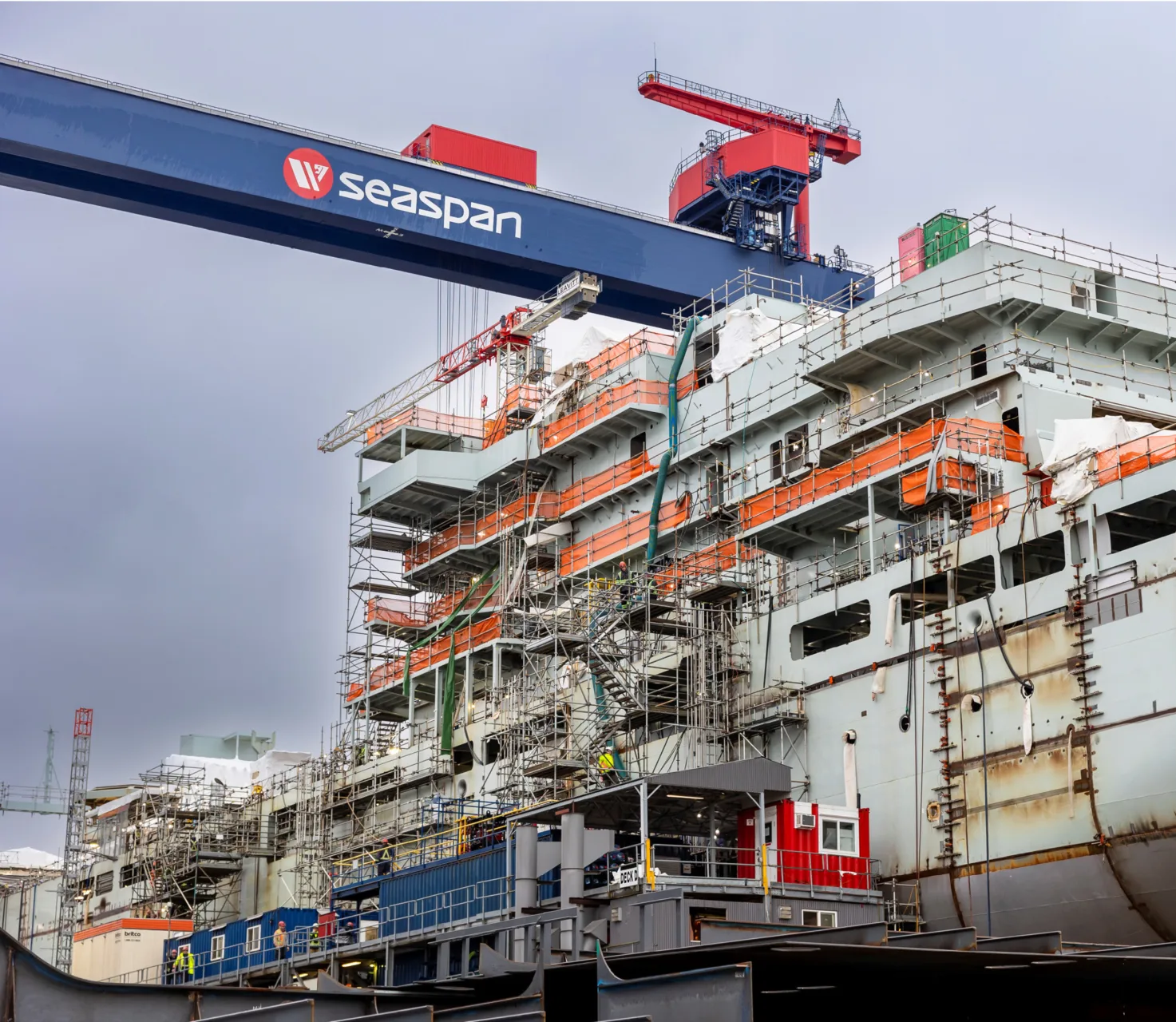
At Seaspan Shipyards in Vancouver, something remarkable happened.
A process that once took weeks and required expert planners to search through massive 3D models, pick thousands of parts by hand, and reconcile everything with planning and ERP systems – is now 75% automated.
What made the difference wasn’t new docks, cranes, or welders – it was software.
Rule-based assembly planning built on Cadmatic’s platform now turns complex designs into usable work packages in minutes. Seaspan planners aren’t spending days clicking through models anymore. Now they review the plan, fine-tune it, and let automation handle the heavy lifting.
This shift is quietly redefining shipbuilding worldwide. Countries from the U.S. to India want to build more ships, but they’re also building the digital systems needed to deliver them reliably, competitively, and at the scale modern geopolitical demands require.
This article explores how nations are shifting from steel-first thinking to digital strategies. It explains the drivers of change, shows how different countries and regions are responding, and outlines what a modern shipbuilding system looks like in practice. It also shows where Cadmatic fits in as a contributor to real-world systems that support this shift.
Why the world is racing to rebuild shipbuilding
Global shipbuilding is changing faster than at any time in the past 40 years. Governments are recognizing the strategic importance of ship construction for trade, naval defense, and maintaining long-term industrial capacity in a decarbonizing world. Three key forces are behind this growing momentum:
1. A concentrated global industry becomes a strategic risk
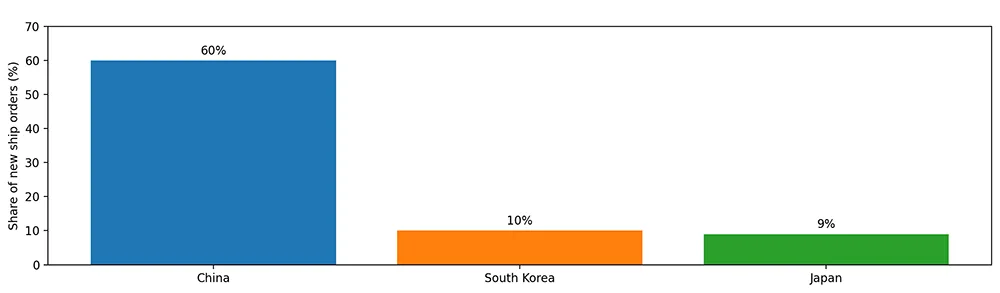
Recent industry reporting shows that global shipbuilding remains overwhelmingly concentrated in East Asia. In 2025, Chinese shipyards again led the market for new orders by a wide margin – capturing over 60% – while South Korea (10%) and Japan (9%) remained the other major players. This reinforces how few countries control the bulk of global shipbuilding capacity and orderbooks.
For the U.S. and its allies, this level of concentration raises concerns. If one country dominates commercial shipbuilding, it also influences the industrial base and supply chains that underpin naval vessels, auxiliaries, and future fleet readiness.
That’s why new partnerships like the US–Canada–Finland “ICE Pact” are emerging. In late 2025, the three countries reaffirmed this framework through a joint statement of intent, aimed at strengthening icebreaker production and reducing dependence on Chinese and Russian capabilities in key regions like the Arctic.
Meanwhile, countries such as India and Indonesia see shipbuilding as a path to industrial growth and stronger naval capability. But they’re entering a market with very different demands compared to the one Europe led decades ago.
2. Climate policy is increasing design and compliance complexity
The IMO’s revised GHG strategy targets net-zero shipping by 2050, with interim goals that require rapid adoption of low- and zero-carbon fuels. However, uncertainty around the 2025 Net Zero Framework has left global carbon pricing unsettled.
Even so, regional policies are having an immediate impact. The EU ETS now applies to large ships entering EU ports and FuelEU Maritime mandates a steady reduction in greenhouse gas intensity starting in 2025.
Ships trading with Europe already face clear economic incentives to reduce emissions. They also need to prepare for a future with multiple fuel types and evolving compliance requirements.
Ship design now requires scenario planning and flexible engineering.
3. Workforces are shrinking while ships become more complex
In mature shipbuilding nations, the workforce is aging and experienced specialists are becoming harder to replace. Emerging shipbuilders may have younger labor pools, but often lack senior expertise in planning, production engineering, and complex vessel execution.
This is why new docks alone won’t rebuild shipbuilding. They need to deliver more output with fewer experienced people, and that makes productivity a strategic priority. Legacy workflows based on drawings, spreadsheets, and manual coordination have become bottlenecks.
No matter the region, the conclusion is the same: physical capacity is important, but digital systems determine how much a shipyard can produce per worker, and how reliably it can deliver complex ships at scale. This is now showing up directly in policy: the U.S. Maritime Action Plan released in February 2026 places workforce training and productivity at the center of rebuilding shipbuilding capacity.
Now that we’ve looked at why the world is racing to rebuild shipbuilding, let’s turn to how selected countries and regions are responding.
How countries are responding to rebuild shipbuilding
United States: rebuilding, but digitally behind
The U.S. Navy remains unmatched, but shipbuilding has declined significantly. Recent reviews point to cost overruns, delays, and digital fragmentation across major yards.
The government is investing heavily in naval shipyard upgrades and considering tariffs on Chinese-built ships. It’s also partnering with allies to expand industrial capacity. Yet many U.S. yards still operate with disconnected CAD, planning, ERP, and paper-based systems.
In February 2026, the White House released a Maritime Action Plan to rebuild U.S. shipbuilding and the wider maritime industrial base. The plan proposes major investment in shipyard modernization and workforce development, alongside mechanisms such as Maritime Prosperity Zones and a Maritime Security Trust Fund to help create long-term demand and financing for U.S.-built vessels.
Modernizing physical infrastructure isn’t enough without addressing digital gaps.
Japan: focusing on integrated simulation
Japan faces strong competition from China and Korea, as well as a declining workforce. Its response has been a nationally coordinated push for digital integration, including the Integrated Simulation Platform under the K Program.
This initiative models the full ship lifecycle from early design through to environmental simulation, including seasonal ocean and weather data. It’s a system-wide strategy built on connected data and simulation.
South Korea: scaling smart shipyards
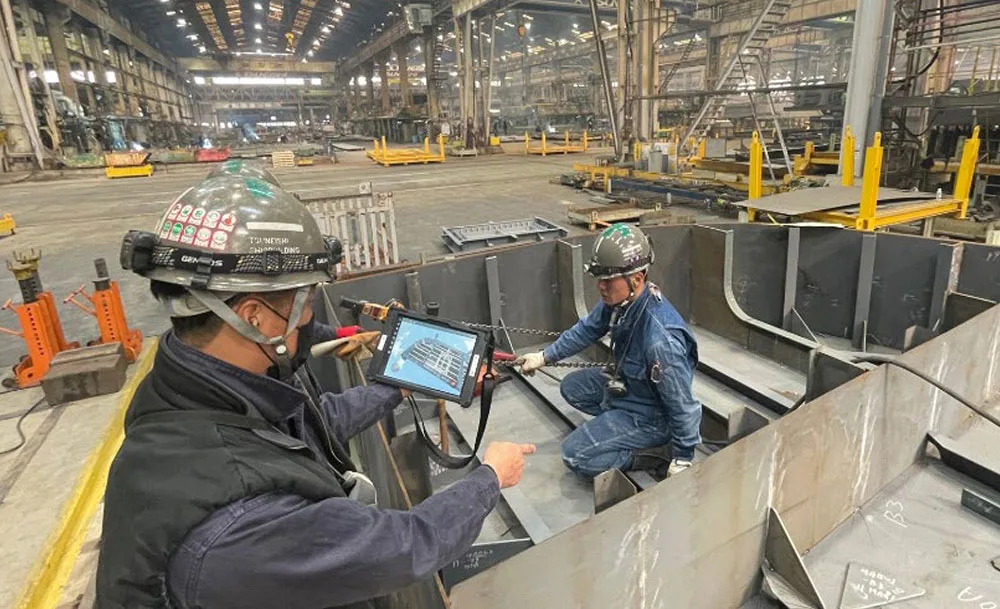
South Korea is already one of the world’s top shipbuilding nations, but it is investing to stay ahead as the industry shifts toward green propulsion, autonomous technologies, and fully digitized production. In 2025, the government raised shipbuilding R&D investment by 40% to about $180m, with funding explicitly split across green shipping, digital transformation of shipbuilding processes, and unmanned autonomous ship technology.
That funding aligns with the K-Shipbuilding Super Gap Vision 2040, a public–private roadmap focused on “super-gap” technologies including automation from design through production and shipyard management. The intent is not simply to build more ships, but to increase productivity and secure strategic technologies at scale.
Europe: managing high complexity under pressure
Europe accounts for just 4% of global shipbuilding output, but leads in cruise ships, offshore vessels, and NATO support assets.
Yards face increasing costs, complex regulations, and tool fragmentation. Some studies show production foremen spend 8% of their time just coordinating information.
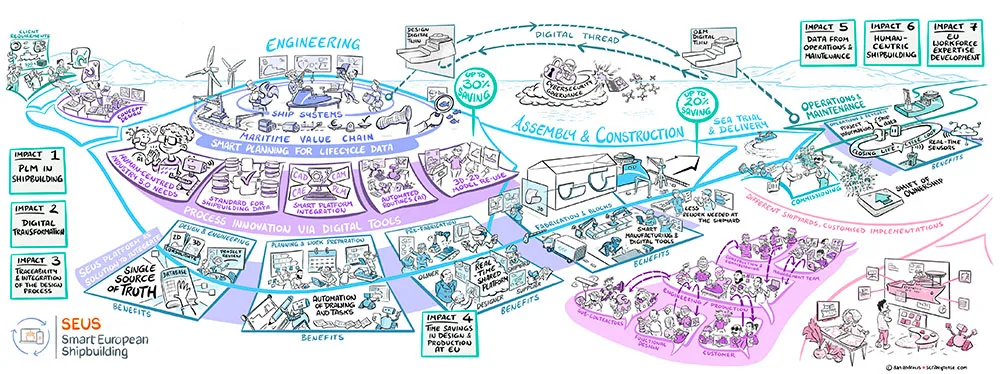
Europe is, among others, addressing this through the Smart European Shipbuilding (SEUS) project, part of the Horizon Europe program. The goal: a unified CAE/CAD/CAM/PLM platform tailored to shipbuilding.
Cadmatic is a core software partner in SEUS, contributing to a European digital system designed to reduce engineering time by 30% and assembly time by 20%.
Canada: executing today and planning for the long term
Canada’s National Shipbuilding Strategy is a multi-decade investment in naval and coast guard renewal.
Its most significant milestone so far: digitalizing production planning. At Seaspan, a 75% leap in automation shows what’s possible when data and planning are connected from design to execution, especially for complex, custom-built Arctic-capable ships.
India and Indonesia: building digitally from the start
These fast-growing economies want to scale shipbuilding capacity quickly and have the rare advantage of not being weighed down by outdated IT systems. Their opportunity lies in designing shipyards around modern, integrated digital workflows from day one.
India’s direction is unusually explicit. Maritime India Vision 2030 lays out a national program to expand ports, logistics, and maritime industrial capability, while Maritime Amrit Kaal Vision 2047 extends that trajectory into a longer-term blueprint for a globally competitive maritime sector.
Middle East: building sovereign capacity through defense, offshore, and MRO
Recent analysis suggests the GCC (Gulf Cooperation Council) has significant headroom to expand shipbuilding and lifecycle services – potentially a multi-decade industrial opportunity – driven by trade flows, defense spending, and offshore demand. Saudi Arabia is also moving from ambition to execution: in 2025, Bahri (the National Shipping Company of Saudi Arabia) placed orders tied to International Maritime Industries (IMI), signaling the ramp-up of large-scale domestic build capability as part of Vision 2030 industrial localization.

So what does a modern digital shipbuilding system look like?
When thinking about modern digital shipyards, it is good to set aside buzzwords like “Shipyard 4.0.” and focus on the following:
1. A single, ship-centric 3D master model
The model becomes the product. It drives all downstream outputs: drawings, materials, work instructions, and change management.
2. Continuity between design and production
Rule-based planning, automated work packages, and feedback loops from the production floor to the design office.
3. Built-in support for decarbonization and compliance
Tools that handle multiple fuel options, complex ship variants, and evolving regulatory reporting.
4. Secure, cross-border collaboration
Most shipbuilding programs involve international stakeholders, including classification societies and local content requirements.
These systems are more than just IT investments and have become part national infrastructure.
How Cadmatic fits into this shift
Cadmatic aligns directly with the digital priorities emerging across global shipbuilding. It provides:
- Ship-specific 3D design tools (CADMATIC Hull, Outfitting, Electrical)
- A shipbuilding-specific PLM platform (CADMATIC Wave)
- Integrated production planning and materials management
- Lightweight 3D collaboration tools (CADMATIC eShare, CADMATIC eBrowser)
Taken together, these capabilities solve the same digital bottlenecks that shipbuilders and governments are tackling across different countries and regions:
- U.S. shipyards struggling with disconnected systems
- Japan’s investment in full-lifecycle simulation
- South Korea’s push for smart-shipyard automation and digital production management
- Europe’s need for unified engineering and production data
- Canada’s drive for scalable, efficient planning
- India and Indonesia’s opportunity to build digital-first infrastructure
- The Middle East’s drive to scale shipbuilding and lifecycle services with digital-first processes
In addition to software delivery, Cadmatic helps define the data structures, workflows, and change management practices that turn strategy into capability. From SEUS to Seaspan, Cadmatic is embedded in the next generation of shipbuilding systems.

Read more about Ulstein Group ASA’s implementation of CADMATIC WAVE here.
Conclusion – the next shipbuilding race is already underway
Around the world, governments are reassessing the role of shipbuilding. But the real contest is no longer about dry docks or cranes. It’s about building digital systems that can turn complex designs into predictable production and support cleaner, longer-lived fleets.
Policy may shift, as seen with the IMO’s Net Zero Framework delay. But the direction of climate risk, financing demands, workforce challenges, and geopolitical pressure is clear.
Countries waiting for certainty will fall behind. Those that treat digital shipbuilding systems as strategic infrastructure will lead the next phase of shipbuilding excellence.