Strengthening risk management in plant operations with CADMATIC eShare

Risk in plant operations is not abstract. It is physical. Operational. Immediate.
It is not a line in a report or a checkbox in a system.
It is a technician climbing to reach a valve that was never designed for safe access.
It is a maintenance task planned without full visibility of nearby hazards.
It is a decision made based on incomplete or outdated information.
And too often, it is hidden in systems that were never designed to make risk visible.
And most of the time, these risks are already known; just not in the right place, at the right time.
They are buried in disconnected systems, scattered across documents, or locked in the experience of individuals. By the time they become visible, they are no longer risks. They are incidents, delays, or costly fixes.
In many projects, risk is addressed too late. During the design phase, owner-operators have the opportunity to carry out a continuous review process, where all relevant experts can contribute and identify potential safety issues early, before they become costly or dangerous in real operations. But when that visibility is missing, risk quietly moves forward into operations. For owner-operators, this is where it becomes real.
A valve installed at high elevation may introduce fall hazards for maintenance personnel, while equipment carrying corrosive chemicals may expose workers to chemical or burn risks. Similarly, heavy components installed without proper lifting access can create dangerous lifting operations.
These are not exceptions. They are everyday realities in complex plants.
Making operational risks visible without replacing systems
Systems such as ERP, CMMS, DMS, and SCADA collect and store critical information.
CADMATIC eShare does not replace these systems. Instead, it complements them by adding what is missing, clarity at a glance.
eShare acts as a visual layer on top of trusted plant information. Operational risks, safety concerns, and maintenance-related hazards can be highlighted through visualization and color coding, directly where people plan work and make decisions.
No new system to learn. No duplicated data.
Just a clearer understanding of risk, when and where it matters.
Visual risk identification through color coding
Risk should not require interpretation. It should be obvious.
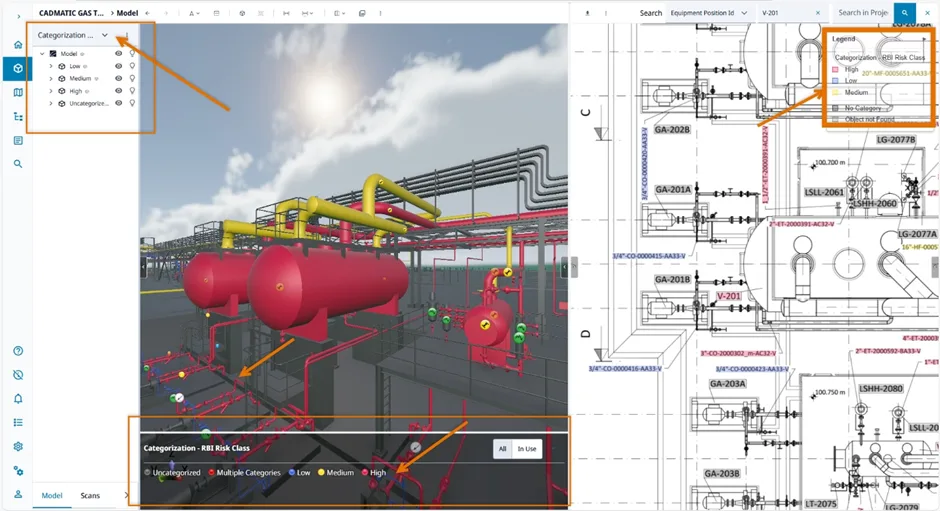
In eShare, risks can be color-coded directly on plant documentation, layouts, and drawings. The status of a risk is immediately visible, even before a single word is read.
- Red signals critical risk and immediate attention
- Yellow highlights risks that must be monitored or mitigated
- Green confirms controlled or resolved risks
This approach removes ambiguity. Risks are not buried in reports or lost in handovers. They are visible, shared, and hard to ignore.
Improved collaboration and accountability
Risk management is not the responsibility of one team.
Engineering, operations, maintenance, and HSE all need the same picture at the same time. eShare creates a shared environment where color-coded risks can be reviewed, discussed, and updated in real time.
When risks are linked directly to plant areas, documents, or objects, ownership becomes clear, along with the next actions. Accountability is no longer implied. It is visible.
Supporting safer and more efficient operations
When risk is visible, behavior changes.
Operators arrive informed. Maintenance is planned better and executed with fewer surprises. Decisions are made with context, not assumptions.
By visualizing operational risks without disrupting existing SAP or other CMMS workflows, eShare helps organizations shift from reactive to proactive, improving safety, compliance, and operational efficiency.
A practical tool for modern risk management
Risk management does not need another system. It needs better visibility.
eShare embeds risk information into daily work by combining trusted plant data with intuitive visual tools such as color-coded risk indicators, while coexisting seamlessly with established enterprise systems.
The result is not more data. It is more informed decisions.