Your digital twin already has the answers
Eighty-seven percent of data leaders believe their data is ready for AI. Forty-three percent of that same group name data readiness as their biggest barrier to getting value from it. Same survey, same people.
That gap is what this piece is about, and it isn’t the AI.
The money gets decided in design
According to the NASA Systems Engineering Handbook, roughly 15 percent of a project’s cost is spent during design. The decisions made in that window commit about three quarters of what the asset costs over its life. The Construction Industry Institute’s Guide to Construction Rework indicates that rework alone eats two to twenty percent of contract value, and most of it starts in design. Design data is where the money gets decided, and the digital twin is where that data lives.
Only 14 percent of oil and gas companies say their digital twin lives up to expectations. Fewer than one in four ever reach full operational deployment. None of that is an AI failure. Those numbers predate the assistant.
The mechanism is simple. The moment a user catches the twin being wrong about something they can check with their own eyes, they stop trusting it about everything they can’t. A twin owned entirely by IT, with operations brought in only after the build, tends to get built and never adopted.
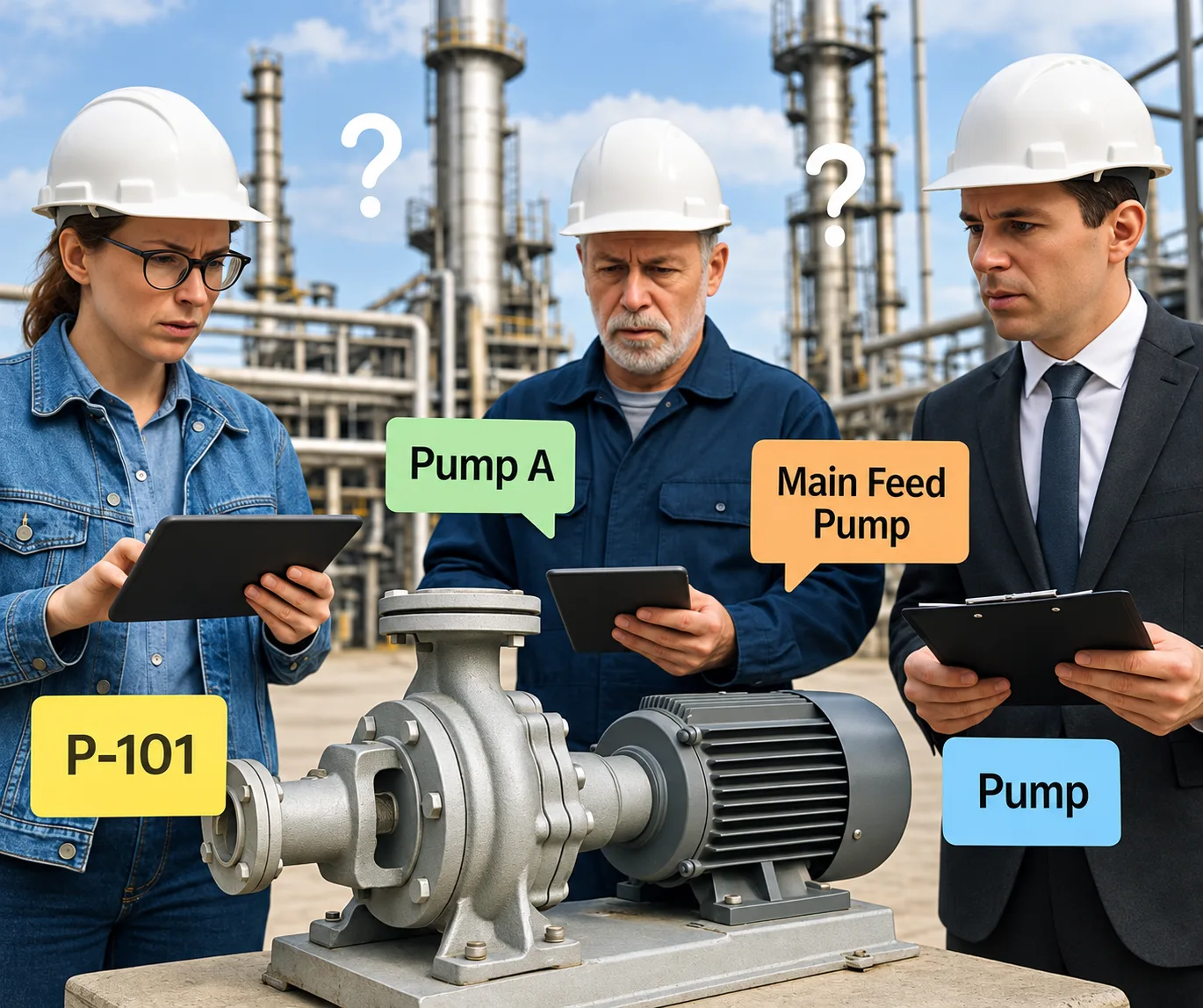
Tagging chaos is the most common cause
Every piece of equipment needs one tag that holds across engineering, procurement, and construction. Instead, every contractor and vendor brings its own convention. A pump ends up as P-101 in the model, 101-PMP in the documents, PMP-001A in procurement. Traceability breaks, and owners stop trusting the twin. None of that starts inside the twin. It arrives from outside, and the owner inherits it.
Catch the mismatch in basic design and it’s a corrected data field. Catch it in construction and it’s a change request, a schedule slip, a cost line nobody budgeted for. By commissioning, it may not be fixable at all.
Point the AI at the data before you point it at the answer
Ask an assistant a question over contradictory data, and nothing tells it the data is contradictory. You get a fluent answer with a citation, and it looks equally authoritative whether it’s right or wrong. That’s the job it was given.
Give the same AI a different job and the picture changes: reading tags out of scans and documents nobody has opened in years, recognizing that P-101, 101-PMP, and PMP-001A are one pump, checking what the P&ID says against what the model says, and surfacing every contradiction with the evidence attached.
Once a twin carries those checks, the same AI is free to answer questions you can act on, run checks without being asked, and predict and generate.
The same check, over the same data, has to return the same verdict every time, and you need to know which revision of the data it ran on. A language model’s wording varies between runs. The verdict can’t.
Four things a twin must do before you ask it anything
Every asset recognized as one thing across every system, whatever each one calls it. Every discipline’s model visible in one view, with no specialist license needed. Completeness visible asset by asset, so you know what’s ready to build and what isn’t. Data fields and document text checked against each other, with the same rule producing the same verdict every time. These are requirements to put to any vendor, before anyone asks an AI a question.
Three layers of intelligence sit on that foundation. Insights is live in plants today: AI reads tags straight out of laser scans and documents nobody has opened in years. Agentic is arriving: the AI calls the check rather than forming an opinion about it, runs your rules as tests every time something changes, and reconciles a deliverable against a subcontractor’s system before it’s ever submitted, with a person approving anything before it’s written. Exploration is next: predictive analytics on the reconciled twin, as-built geometry rebuilt from the scan, designs searched against requirements and cost.
This is already running in three plants
At Argent Energy’s BDAII biodiesel plant, owner, engineers, and contractors work from one twin. Contractor progress sheets are imported and color-coded, and progress is marked directly on the model.
At Yara Suomi Oy, “eShare ties documents, diagrams, and ERP links into the same view – it helps keep the plant model’s data in good shape,” says Heikki Lehto, Head of Projects.⁶
Bonatti, an EPC in oil and gas, color-codes progress, quality control, and handover on the twin. Their condition is non-negotiable: the information management solution must be “independent from the design packages used by our contractors.”⁷
On a live project today, a revised line becomes one question instead of an afternoon across three systems: show me everything linked to it, pulled from the register and the model rather than a guess. A contractor asking the same question gets only what their access already allows.
Design commits the cost. Unchecked data hides it. AI rebuilds the trust.
The answers are already in your twin. Let AI make them trustworthy.
If you’re at Future Digital Twin & AI Amsterdam on 18 September, I’d love to see you there. I’m speaking at 12.55, and the Cadmatic team is on hand at the Cadmatic booth with tag-reconciliation and change-impact demos. Come by and see what a twin looks like once the data underneath it can be trusted.