Foundation for unified shipyard operations and predictable delivery – Cadmatic Wave

Shipbuilding is defined by complexity. But what drives cost, delay, and risk is not complexity alone. It is the fragmentation behind it.
Across a shipyard, engineering, procurement, production, and project execution often operate through different structures, different tools, and different timelines. One team works by system, another by area, another by block, another by supplier package. Critical information is spread across documents, issues, changes, spreadsheets, and local team practices. The result is familiar: slower decisions, avoidable rework, weak visibility across disciplines, and unnecessary pressure on schedule, margin, and delivery performance.
Shipyards do not need more disconnected systems to manage that complexity. They need better control across the systems, structures, and processes that already shape the vessel and the project.
Cadmatic Wave is built for that reality. It provides a connected shipbuilding backbone that brings together product context, documentation, requirements, changes, issues, and engineering project execution visibility in one environment. Wave is designed to bring that complexity under control by connecting the operational context of the shipyard in one environment.
The result is not just better information management. It is stronger operational control across the shipyard.
One vessel, multiple business views
A ship cannot be managed through a single structure
- Engineering needs a functional view
- Production needs a build view
- Planning needs spatial and sequencing context
- Procurement needs package and supplier scope visibility.
Wave supports these parallel views in a connected way, using the shipyard’s own coding and decomposition logic rather than forcing one fixed model. This can include system structures, spatial structures, assembly or manufacturing structures, and module-based scopes.
Each function can work in the structure that matches its responsibility, while management still sees one connected reality. That improves alignment across disciplines, reduces ambiguity, and helps the yard make better decisions on sourcing, planning, sequencing, and execution.
Earlier control through connected TAG management
In shipbuilding, TAGs are more than equipment identifiers. They are an early way to define the ship functionally before design is complete. Wave gives shipyards a shared TAG backbone across disciplines, making tags traceable, reusable, and connected to the rest of the ship context from the start.
This supports earlier planning and better control. It helps shipyards define long-lead items sooner and avoid the fragmentation that happens when each discipline builds its own interpretation of the same equipment. In practice, it improves readiness before engineering has fully matured.
Change management with real impact visibility
In complex shipbuilding programs, the challenge is not only having changes. The real challenge is understanding what else the change affects. Wave manages engineering changes in context, linking them to systems, areas, blocks, modules, documents, and requirements managed as structured data objects. Because requirements can be connected to multiple parts of the vessel definition, a change can be assessed beyond the immediately affected object.
This supports more reliable impact analysis. When one part of the vessel changes, the yard can trace what other objects, deliverables, and disciplines may also be affected. That leads to better change decisions, fewer hidden downstream impacts, and stronger control over schedule, cost, and execution risk.
Documentation as managed context, not file storage
In Wave, documents are not treated as isolated files. They are managed data objects with their own metadata, lifecycle, status, and relationships to other relevant objects. A document may contain multiple files, but its value lies in the controlled context around it.
This gives the yard better control over documentation quality, maturity, and traceability. Teams do not just store files. They manage deliverables in relation to the systems, tags, requirements, changes, and project activities they belong to. That reduces manual chasing, improves visibility, and supports better decisions with less effort.
Better control of the work that was never in the original plan
Shipyards usually know how to structure formal project deliverables from the technical specification. But real execution does not stay within the plan. Especially on the first vessel of a class, production often starts while engineering is still evolving. That creates a large volume of unplanned tasks, open issues, and claims that need to be managed quickly and in context, without turning every situation into a heavy formal change process.
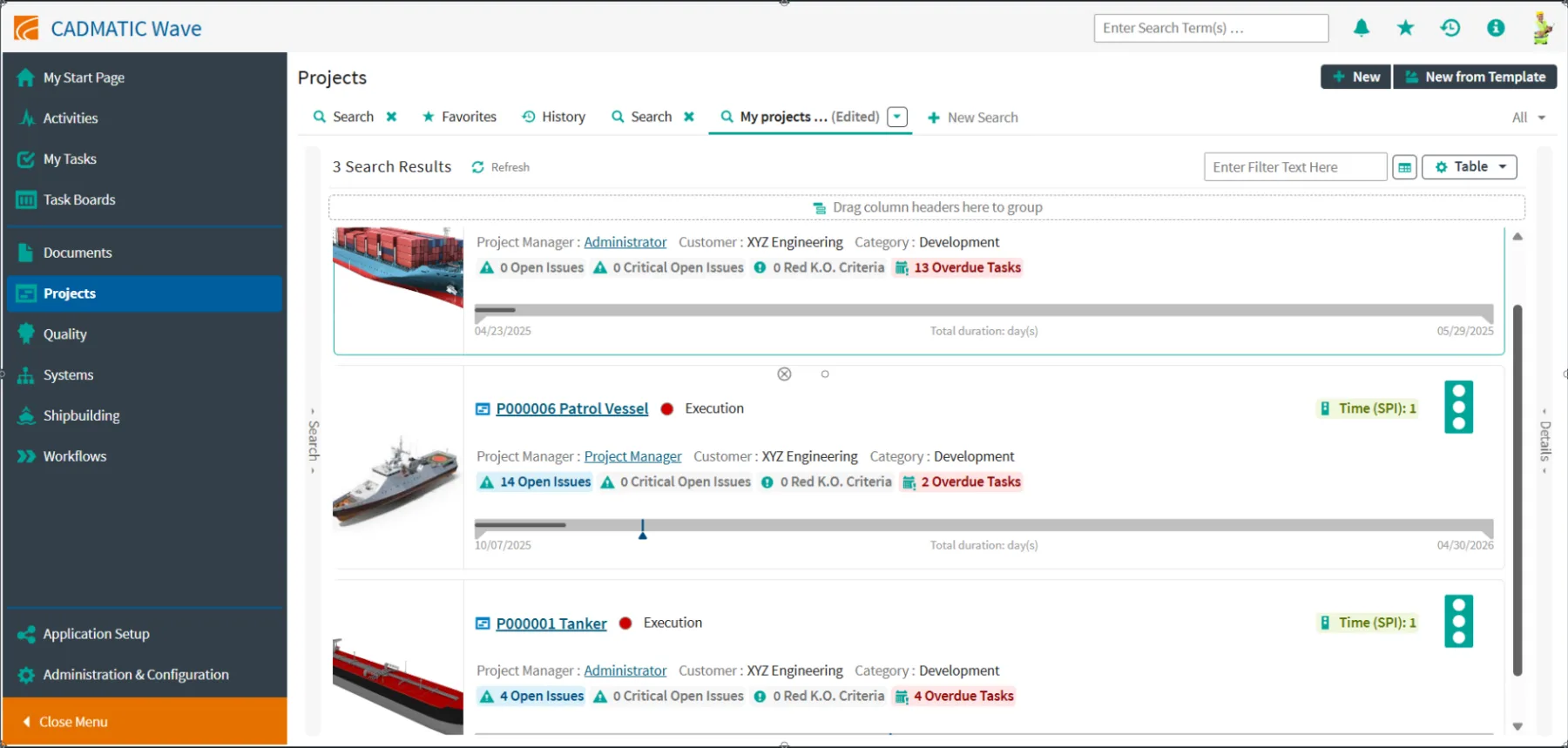
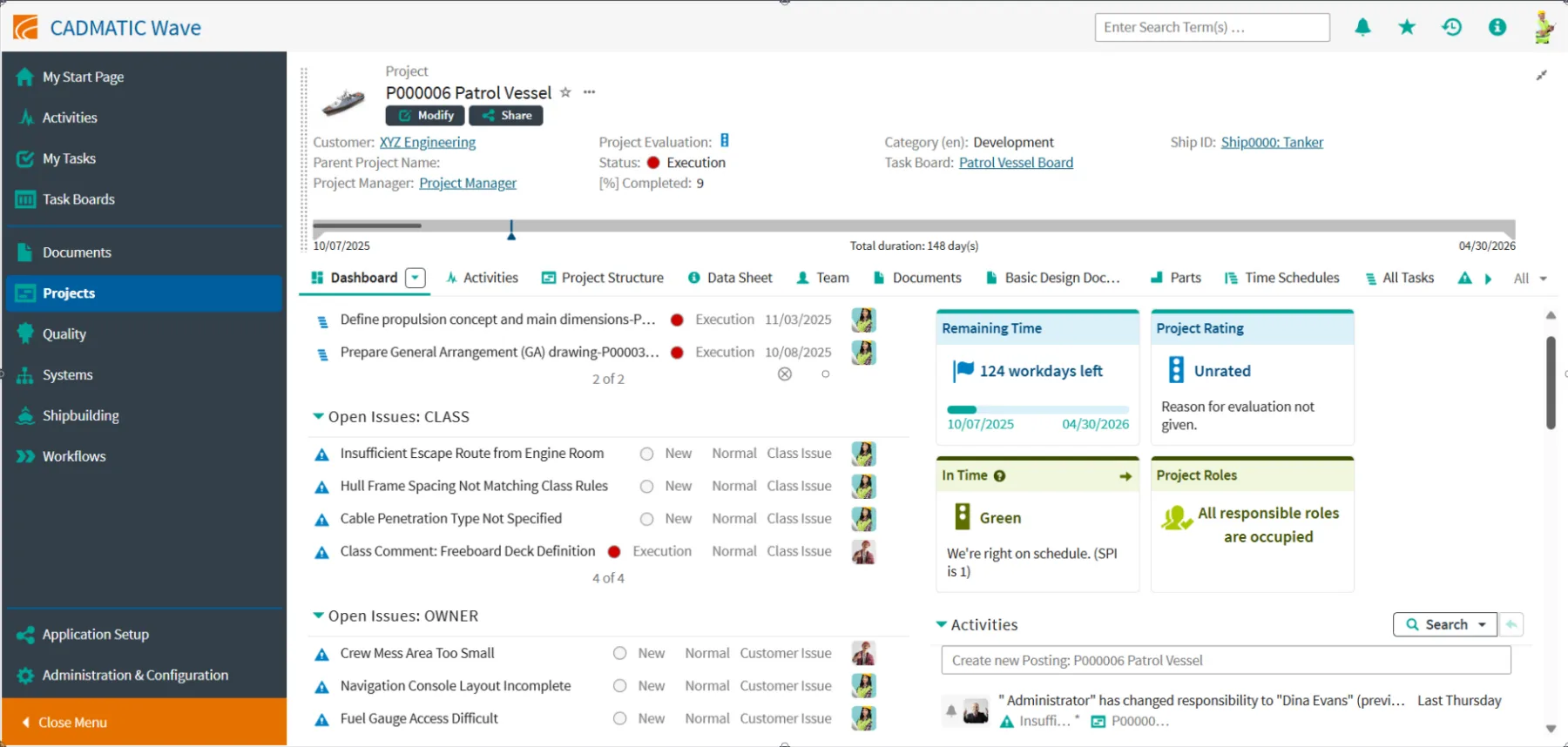
Wave brings project tasks, open issues, and claims together in one connected environment and links them to the relevant ship context, such as a system, zone, block, module, or document set.
This gives project managers and team leads much better situational awareness. Instead of chasing separate task lists, issue logs, and commercial records, they can see what is happening across the vessel in one place. That improves prioritization, accelerates coordination, and helps contain operational and commercial risks before they grow.
Reuse and make-or-buy decisions at the right level
Wave supports standard libraries and part management, but the bigger value comes from managing broader executable scopes as modules. Instead of thinking only in individual parts, the yard can define meaningful installable, prefabricated, or outsourced packages that reflect how the ship is actually engineered, sourced, and built. The underlying multi-structure model also supports grouping objects across different structures for planning purposes.
This improves more than engineering reuse. It strengthens make-or-buy decisions, clarifies supplier scope, supports prefabrication and outsourcing strategies, and helps standardize repeatable solutions across projects. In business terms, it gives the yard better control over package-based execution.
Faster alignment through structured review and redlining
In large projects, delays are often caused by unclear feedback loops rather than missing data. Wave supports structured review and redlining workflows so comments, issues, and decisions can be captured and resolved in the right context.
This reduces misunderstandings, shortens approval cycles, and improves design quality. More importantly, it lowers the dependency on fragmented communication through email, meetings, and disconnected markup files.
BOM control that supports real shipyard execution
In shipbuilding, BOM management must support more than material listing. It needs to serve engineering, procurement, supplier deliveries, modules, and production planning at the same time. Wave supports BOM control in a connected context, so material and component information can be viewed in the way the yard actually needs to source, assemble, and deliver the vessel. The broader shipbuilding data model also supports using connected structures to derive planning- and production-relevant BOM views.

Wave helps shipyards reduce the number of isolated systems involved in managing engineering and project execution. Instead of spreading critical information and coordination across separate tools, teams can work in one connected environment built around the actual context of the vessel and the project. That means less fragmentation, less manual handover work, better visibility across disciplines, and stronger control over changes, issues, deliverables, and execution risk.
Wave reduces the operational cost of fragmentation by replacing disconnected point solutions with a connected shipyard data and process backbone.
The real business impact: Better control of schedule, cash flow, and risk
When critical shipyard information is managed across disconnected tools, the cost is not only inefficiency. It is slower decisions, weaker coordination, hidden risk, and unnecessary loss of margin. Wave helps reduce that fragmentation by bringing product context, documentation, tasks, issues, changes, and execution visibility together in one connected environment.
The business impact is practical where it matters most: less manual coordination, earlier visibility of emerging problems, stronger alignment across disciplines, and more predictable execution of complex projects. That matters not only operationally, but financially. In large shipbuilding programs, delays can significantly increase financing exposure because a substantial share of yard revenue is often realized only at delivery. Delays may also trigger contractual penalties, which can become a serious financial burden. And the impact rarely stops with one vessel. When planned dock or erection time extends, it can disrupt the start of the next ship and create a cascading effect across the yard’s delivery schedule.
In short, better execution control supports better control over margin, cash flow, and yard capacity.
Built for shipyards, not adapted to them
Shipbuilding is not a standard manufacturing problem. A vessel must be managed through multiple parallel realities at once: systems, spaces, blocks, modules, supplier scopes, documents, requirements, and evolving project execution. At the same time, engineering, procurement, and production operate at different speeds, often with production starting before engineering is fully complete.
Wave is built around that reality. It supports the structures, relationships, and execution context that shipyards actually depend on, instead of forcing shipbuilding work into a simplified model designed for another industry. This gives shipyards a better fit from the start, reduces the need for workarounds and parallel tools, and creates a stronger basis for operational control across the full delivery process.
A foundation for future shipyard capabilities
Shipyards will face growing demands beyond today’s delivery pressure: stronger traceability, closer supplier coordination, tighter compliance expectations, sustainability reporting, and the need to improve reuse and execution predictability across projects. Those demands should not be met by adding more disconnected systems. They require a stronger operational backbone.
Wave provides that foundation by connecting product context, requirements, documents, changes, issues, and execution visibility in one environment. This helps shipyards strengthen current project control while creating a practical basis for future capabilities without increasing fragmentation.
The value is not only better performance today. It is the ability to respond to tomorrow’s demands on top of a more coherent data and process foundation.
See how Ulstein Group ASA is putting these principles into practice with Wave.