Four ways AI is reshaping software development – and why Cadmatic is hiring three Engineering Managers
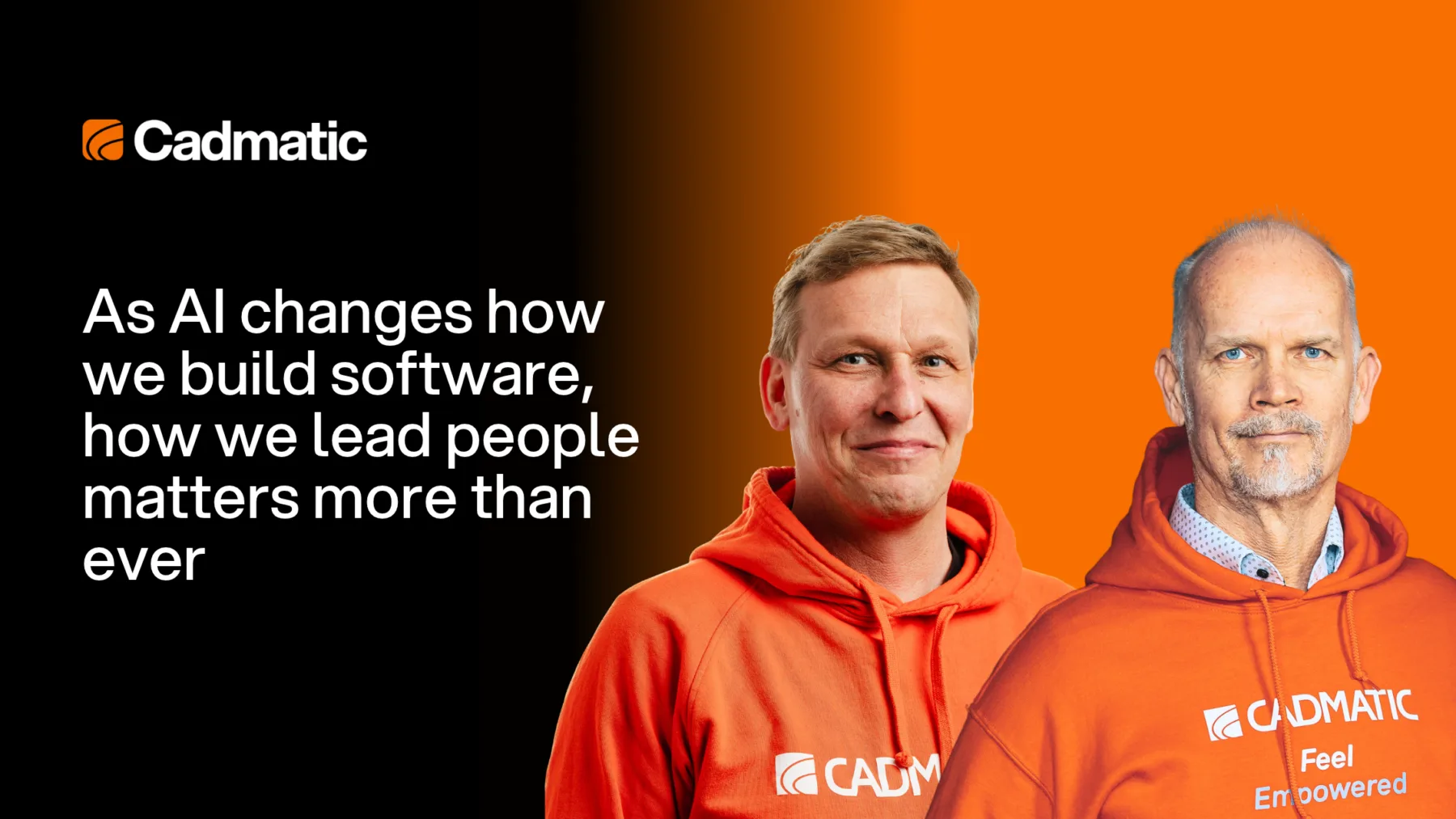
Software development is changing fast! AI is reshaping how we write code, define requirements and build products. And with that change come new questions:
- How should development teams work in the future?
- What skills will people need?
- And how do you make sure everyone has the support to grow along the way?
That’s why we’re introducing three new Engineering Manager roles to our Product Creation organization: two in Finland and one in the Netherlands.
Our CTO, Timo Kaltio, and Vice Presidents, Product Creation, Mikko Yllikäinen and Aki Nupponen talk about what’s changing, why we’re making this move and what it means for our people and future Engineering Managers.
Four beliefs shaping the future of engineering – and how they’re changing our organization
1. As AI transforms software development, people leadership needs more attention, not less
As Cadmatic grows, our product development teams are working more closely across products, teams and countries. At the same time, AI is changing how development work is planned and carried out.
Until now, many of our Product Owners have combined product responsibilities with line management. As the organization grows and work evolves, both areas need more dedicated attention.
“Sometimes one side ends up taking most of the time, even though both are extremely important,” Mikko says. “We want to make sure that there is enough time for both roles.”
The new Engineering Managers will focus on people leadership, skills development, well-being and helping teams improve their ways of working. Product Owners will continue to guide product development, including priorities, sprint planning and release responsibilities.
“Now with the introduction of Engineering managers, Product Owners can focus fully on their products. At the same time, we have someone whose only role is to look after people, their skills, and their well-being,” Mikko says.
This is about strengthening our organization as we grow, not reducing headcount. And while developers’ daily work may not change immediately, the goal is to build better ways of working over time.
2. AI is changing more than how we write code – it’s changing how teams work
AI is changing more than how quickly we can produce code. It’s making us rethink how we define requirements, evaluate results and organize development work.
And we’re learning as we go!
Aki shares an example from his own experience. Earlier this year, he believed AI would make detailed specifications increasingly important. Just six months later, he had seen how an iteratively developed prototype could itself serve as a specification.
“I’ve completely changed my view in half a year,” he says. “Others might still see it differently, and I don’t know if there is a right or wrong answer yet.”
For Timo, who has led several major organizational changes during his career, the important thing is creating the conditions for people to adapt.
“People need the skills, the motivation, and the time to learn,” Timo says.
This also means being open to different approaches across our teams. With 10 product teams and 15 main products, one way of working won’t necessarily suit everyone.
“We don’t have one solution that we roll out everywhere,” Timo says. “We need to try things, learn, and see what works.”
“With 10 product teams and 15 main products, we don’t have one solution that we roll out everywhere. We need to try different approaches, learn, and see what works.”
— Timo Kaltio
Our new Engineering Managers will have an important role in this journey: listening to teams, understanding where support is needed and helping people develop new skills and practices together.
And as AI changes the development process, the experience our people have built over the years remains valuable. Understanding our products and customers helps us make good decisions about what to build and how to evaluate the results.
3. Technology will keep evolving, but great engineering starts with people
While our technology and ways of working evolve, there are things we want to preserve. For Aki, who has worked with many of his colleagues for years, one of those things is an open atmosphere where people are recognized as individuals.
“A person isn’t just a resource. A person is a person,” he says.
It’s a simple thought, but an important one for how we approach leadership.
For Mikko, who joined Cadmatic more than 19 years ago, our value of succeeding together means sharing successes, working through challenges and taking pride in what we accomplish as a team.
And there’s plenty to be proud of.
Our software is used to design everything from cruise ships and icebreakers to nuclear power plants. It’s even been used to design a luxury hotel pool area in Dubai covering roughly two football fields.
“When you see one of these amazing things – be it live or in the media – you can be pretty proud to be able to point to it and say: that’s made with our software,” Mikko says.
“When you see a cruise ship, an icebreaker, a nuclear power plant or another amazing project designed with Cadmatic software – be it live or in the media – you can be pretty proud to point to it and say: that’s made with our software.”
— Mikko Yllikäinen
As we grow, we want to maintain that sense of connection: to our colleagues, our products and the impact of our work.
The new Engineering Managers will help us do that by supporting experienced teams, recognizing individual needs and creating opportunities for people to develop.
4.The future of engineering is built through collaboration, not organizational boundaries
Our Product Creation organization is international, and so is this change. Two of the new Engineering Managers will be based in Finland and one in the Netherlands. All three will report to the same Vice President in Finland and work together as part of one global organization.
Collaboration across locations is already part of our everyday work. People work together regardless of where they are based, and teams share practices across countries.
At Cadmatic, collaboration isn’t defined by location. Our teams work across countries, share what they learn and develop better ways of working together.
The new Engineering Managers will build on that foundation, learning from one another as their teams experiment with different approaches.
It’s also an opportunity to make career paths clearer when people management and product definition are clearly separated into distinct roles.
Want to help engineering teams thrive as software development evolves?
You know that great engineering leadership isn’t just about processes, technology or getting things done. What matters is understanding people, helping them grow and creating the conditions for teams to do their best work.
And when AI is changing how software gets developed, that responsibility becomes even more interesting.
As an Engineering Manager at Cadmatic, you’ll have the opportunity to help experienced software teams navigate this change. You’ll bring your understanding of software engineering and development processes, while working closely with Product Owners, fellow Engineering Managers and our Product Creation leadership team to develop better ways of working.
You won’t be expected to have all the answers from day one. What matters is your ability to listen, learn and understand what different people and teams need to succeed.
As our CTO Timo puts it:
“It means seeing and hearing the person, and understanding how they are coping with the change.”
And what could success look like? Not necessarily a big transformation everyone talks about, but meaningful improvements that become a natural part of everyday work.
“If we get this right, a year from now it won’t feel like a change anymore. It will feel like the way things should have been all along,” Mikko says.
Explore our Engineering Manager opportunities and learn more about joining Cadmatic!
If you’re motivated by helping people grow, developing how engineering teams work and making a difference through your leadership, this could be an interesting next step in your career. We’re hiring three Engineering Managers: two in Finland and one in the Netherlands.