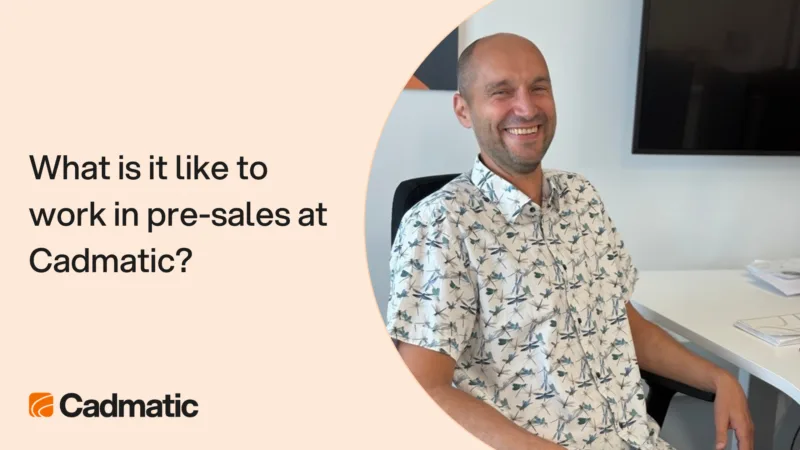
“Never become a consultant,” Antto Heino’s teacher said. Here’s how it went:

On one of his first days at Karelia University of Applied Sciences, Antto Heino’s study counselor gave the Electrical and Electronics Engineering class some advice. Do whatever you want with your careers, the counselor said, but whatever you do, don’t become consultants. Antto remembered it and spent years as an electrical designer.
Then he joined Cadmatic, and recently he became a Senior Application Consultant.
“I think this circle has finally closed,” he says.
If you’ve read Antto’s earlier story, you know how his journey at Cadmatic began: the years as an electrical designer, the switch to Cadmatic in 2021, and the work of connecting customer needs with the technical capabilities of Ship & Industrial Plant Engineering Software. But what has happened after that?
Career growth from the customer training room to the pre-sales stage
Around eighteen months ago, Cadmatic reorganized its pre-sales function. For Antto, it quietly changed his daily work.
“The volume of customer training I do has decreased significantly. I’m now mainly supporting sales within the pre-sales organization,” Antto says. “Sales has become a much bigger part of my daily work. I’ve had to learn a bit of the sales jargon.”
In practice, the change means a different kind of thinking entirely. When a deal is already done and a customer needs training, you’re helping people get comfortable with a system they’ve already committed to. In pre-sales, you’re running one or two-hour demos to customers who haven’t decided yet, and your job is to show them something that makes the decision clear.
“You have to be able to read what the prospect needs based on what the sales organization tells you,” Antto explains. “You need to convince them in a completely different way than when the deal is already done.”
What makes that harder than it sounds is that customers rarely tell you exactly what they’re looking for. They come in with a problem, sometimes with a vague sense of what they want to see, and it’s Antto’s job to pick up on the signals in the room: a question asked twice, a moment of hesitation, a detail they keep coming back to, and steer the demo in that direction without being asked to.
“You’re not just presenting software. You’re listening for what isn’t being said and making sure the demo answers that, even if no one has put it into words yet.”
A small town on the Atlantic coast that Antto now calls his French hometown
One project has stayed with Antto more than most. A shipbuilding company based in a small town near Nantes on the French Atlantic coast, a place Antto now half-jokingly calls his French hometown, after three visits.
It started as a proof-of-concept project for the customer. He flew out to France, ran the product demo on site, and they weren’t yet a Cadmatic customer. Today, they’ve been collaborating for two years.
“It’s probably one of the most interesting projects I’ve been involved in, professionally speaking,” he says.
The broader shift in Antto’s customer base mirrors this story. When he joined Cadmatic, he worked almost exclusively with Finnish clients. Today, the majority of his work involves global companies operating in marine, industrial, and plant environments across multiple countries and bringing international teams to the table.
“The language switched to English. But more than that, the industries changed,” Antto says. “Building services, which I did a lot of before, I do very little of now. Marine and industrial work has taken over. These are organizations that aren’t small local firms. They’re global operators, and the culture you get to participate in is already quite multinational.”
What demanding clients teach you as a consultant
Some customers know exactly what they want. The project in France is one of them.
“They come in with very precise ideas about how things should work. Sometimes we have to bend our Engineering software to fit their needs,” Antto says. “The customers clearly know what they want. Our job is to listen and work together with product development to solve it, even when there’s no ready-made solution.”
Working in shipbuilding and marine environments has also meant getting used to a different pace and a different set of expectations. These are industries where processes are thorough, standards are high, and many more people are involved in decision-making. It’s a contrast to the building industry, where speed and efficiency tend to drive everything.
“Electricity is the same everywhere: lights come on in a ship the same way they do in a hospital,” Antto says. “But the process of designing that electrical equipment for a ship is heavier. More people are involved. The requirements are documented differently. It takes getting used to.”
What grows in your daily work alongside a title
The move from Application Specialist to Application Consultant was part of the pre-sales reorganization. The Senior title came in June. Antto is straightforward about both: they reflect something real, but neither one changed his work overnight.
“Autonomy and responsibility will grow even more,” he says. “Not that I was overly managed before, but now, the freedom and responsibility will expand further.”
What has genuinely changed is harder to measure. Two or three years ago, every client meeting came with nerves, even for someone who had performed as a pianist on stage since childhood. Now, Antto walks into demo rooms in front of engineers he’s never met and feels something close to routine.
“I’ve built up routines almost everywhere. It doesn’t feel the same anymore. I dare to go and speak about these things anywhere.”
Looking ahead, Antto isn’t chasing management. What he’s after is more of what he already has.
“This is probably the most enjoyable work I’ve done. I like the pre-sales phase more. I hope these tasks stay and maybe, as I get more experience, I can start pushing my own perspective into the mix a bit more.”
As for the teacher who said never to become a consultant?
“It’s only a title in the end. What matters is the work and how you do it. But I think it was said with a wink, a Nokia-era dig at desk consultants. I think the circle has closed now.”