We’re building AI for the people who design ships and plants
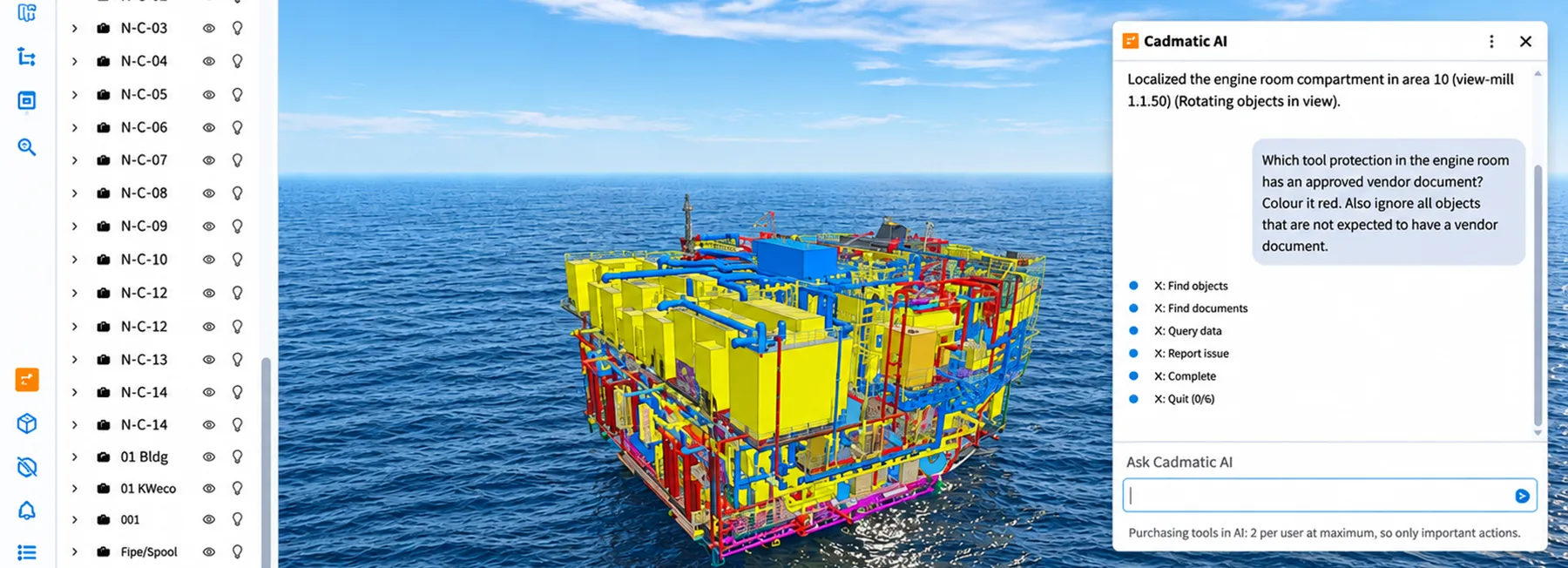
About 15 percent of project spending goes to design. According to the NASA Systems Engineering Handbook, that phase commits roughly 75 percent of what the asset will cost over its life. The Construction Industry Institute puts rework at 2 to 20 percent of contract value, with most of it starting in design. Those numbers are why I’m convinced AI belongs in design and in every handover that follows. It belongs right next to the engineers making the decisions.
Too much engineering time still goes to setting up equipment libraries or hunting for a tag in a document nobody has opened in years. We want AI to take that routine work off your desk.
A decision you make in design should still hold at the yard or the construction site, and years later in the engine room or the control room. Today that connection is rebuilt by hand at every handover, and something gets lost each time. We are building our AI to do the reconnecting between phases, and you keep the final say on every decision.
Our AI is built for ship and plant engineering
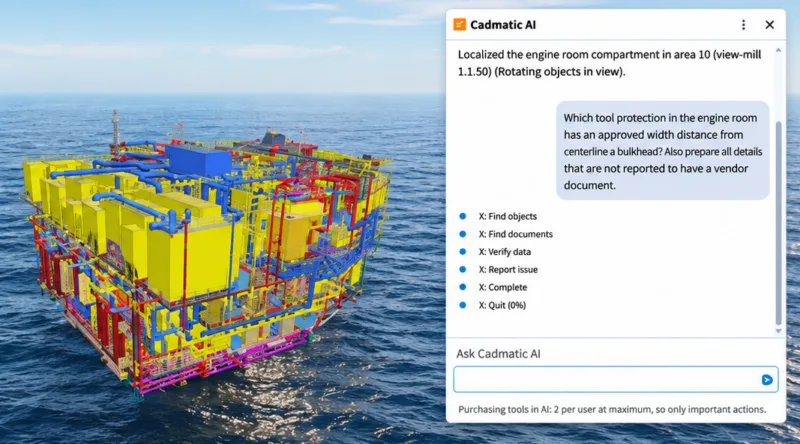
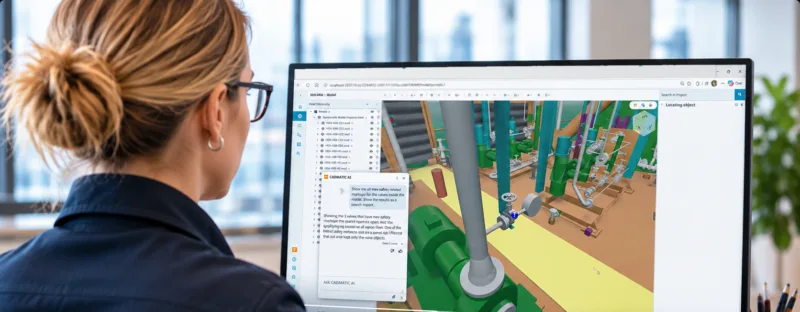
Cadmatic builds software for ship and industrial plant engineering, and we’ve chosen to go deep on those two. Our AI knows what a bracket type file is, and why a tag in a laser scan has to match the one in your model. It works inside the Cadmatic tools your teams already use, on your own models and data.
It’s available through a Cadmatic One License subscription. It’s also open, so if we don’t offer everything you need yet, you can build on top of it.
Plenty of it is already running in your software
We group our AI by how it helps: it can do something for you, show you something, or help you discover something.
In Cadmatic Electrical, the AI assistant already makes library and equipment setup up to 50 percent faster. In Cadmatic Hull, you describe a bracket in plain engineering terms, and Hull generates and reuses the type file, cutting manual effort by up to 75 percent.
In plants, AI can read tags from laser scans and long-forgotten documents. It also helps you spot tagged equipment that has no document linked to it, or that shows up in your scans but not in your model.
More is on the way
Here is a selection of what we’re working on now:
- Routing suggestions for piping, cabling, and structural layout
- An agent that turns written specifications into a first structural model
- Product libraries created and maintained by AI, including lugs, holes, end cuts, and equipment
- Classification society and yard specifications turned into automatic welding rules
- Continuous validation against classification and regulatory standards as the design develops
Further out, we’re developing generative hull design, where AI proposes hull forms optimized for weight, strength, or cost. Some of this is a few years away, and we’ll be straightforward about timing as each piece gets closer.
Our new AI page brings it together
It shows what’s running today and what’s coming next, with the videos and resources behind it. If you’d like to see where AI fits into your own projects, talk to one of our experts.
Visit the new Cadmatic AI page.